Root damage of street trees in urban environments: An overview of its hazards, causes, and prevention and control measures
Street trees constitute an integral part of a sustainable urban environment and have increasingly been recognized for their contributions to climate regulation, human health, and habitat improvement. Apart from their various ecosystem services that improve urban residents' quality of life (Bolund and Hunhammar, 1999; De Ridder et al., 2004; Elmqvist et al., 2013), street trees reduce stormwater run-off (Xiao and McPherson, 2002), mitigate urban heat-island effects (Qi et al., 2022a; Qi et al., 2023), promote soil consolidation and slope protection (Xiaogang, 2013), improve air quality (Beckett et al., 1998), reduce noise (Lohr et al., 2004), and enhance biodiversity (Villaseñor et al., 2021). Additionally, they enhance the aesthetics of urban landscapes and contribute to their cultural significance (Qi et al., 2022b).Despite such benefits, street trees cause certain ecosystem disservice (EDS) (Delshammar et al., 2015; Lyytimäki and Sipilä, 2009; Von Döhren and Haase, 2015). Chief among these is the physical destructive threat posed by tree roots to surrounding grounds and subsurface hard bodies, also known as root damage (Wagar and Barker, 1983; Wong et al., 1988).
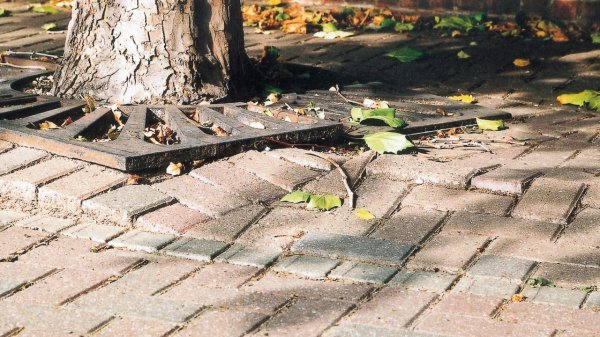
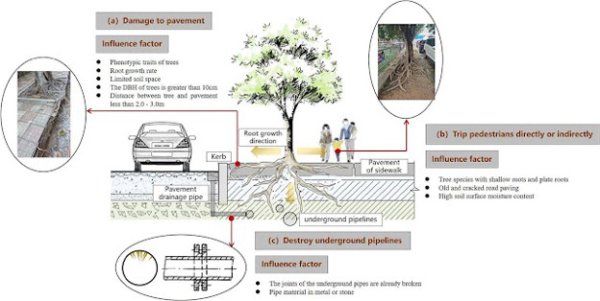
In cities, the root systems of some street trees insidiously endanger public properties, often structurally compromising sidewalk surfaces, curbs, and underground pipes. Above the ground, root damage causes sidewalk protrusions, while buttress roots may trip pedestrians (Smiley, 2008). In this regard, the magnitude of root-induced infrastructural problems is reflected by the annual expenditures from urban forestry or greening budgets earmarked by governments to address them. A research report, using Beijing as a case study, indicates that the total value of EDS in the city was approximately 10.54 billion RMB in 2019 (Wu et al., 2021); root damage, which formed part of the EDS, imposed a burden on local governments. Further costs have also been incurred on both regional and national scales (Table 1), including tree maintenance, infrastructure maintenance, and compensatory damages paid to injured pedestrians. Across China, the United States, and Canada, tens of millions of dollars may be spent annually to address root damage issues.Much literature worldwide has demonstrated the detrimental effects imposed by the root systems of street trees on infrastructures and pedestrians. In the USA, a 1974 survey in the San Francisco Bay Area found that >60 % of street trees had induced at least minor damage (Hamilton, 1984). Corroborative evidence also came from a 1986 investigation in Manchester, the United Kingdom (UK), reporting that, of the 2232 surveyed street trees, the rates of damage to sidewalks and curbs were respectively 30 % and 13 % (Wong et al., 1988). Additionally, a joint American and European review has concluded that 50 % of sewer blockages were caused by tree roots (Randrup et al., 2001b); in Denmark and Sweden, the datas rose to 97 % and 99 % (Randrup, 2000; Stål, 1998).
Lastly, root damage is known to shorten the service life of pavements and municipal plumbing facilities.Causes of underlying root damage of urban trees and street trees have been examined for more than six decades across regions including America, Asia, Europe, and Oceania (Edgar, 1962). A multiplicity of causes has been identified: tree species (Zhang and Huang, 2009); tree physiology (Östberg et al., 2012); soil-space limitations (Wong et al., 1988); soil composition under pavement surfaces (Johnson et al., 2019); water content in shallow soils (Watson et al., 2014); and the proximity of planting holes to sidewalks (Randrup et al., 2001a). Of these, tree species is usually considered to be the primary factor governing root damage. For example, fast-growing species such as poplar (PopulusL.), eucalyptus (Eucalyptus spp.), and ficus (Ficus microcarpa Linn. f.) tend to induce root damage. Moreover, the extent of root damage varies between species (Zhang, 1999).
However, studies have found that the damage caused by root intrusion varies depending on the different pavement materials and construction methods used. The uplift or cracks in sidewalks may be primarily attributed to the inherent strength or weaknesses of the pavement materials themselves or failures in the engineering design, rather than being solely caused by the roots of street trees (Coder Coder, 1998).For root intrusion into underground pipes, the spaces between pipes and roots and the gaps between pipe joints have been considered the main causes of root damage (Bosseler et al., 2004). Although the exact mechanism has not been fully elucidated, the intrusion of roots into the sewer pipes is likely due to the hydrotropism of roots, which causes them to be attracted to the water leakage at the pipe joints. (Fransson, 2019).
Various methods have been proposed to prevent and control root damage from street trees, including tree species replacement, canopy pruning, reprogramming living spaces, and the use of root barriers. However, each method has its limitations and considerations. Tree species replacement, although commonly used, may face resistance from residents who value the benefits of existing trees. Canopy pruning can limit root growth (Jones et al., 1998), but excessive pruning may negatively impact tree health (Coder et al., 1997). Reprogramming living spaces of street trees can be a viable alternative, provided sufficient space is available for modification. However, there are variations in urban street-tree planting hole specifications across regions. Lastly, root barriers, such as chemical inhibitors or physical hindrances, can restrict root growth but may have drawbacks such as inconsistent effectiveness and potential harm to tree health (Morgenroth, 2008; Thompson and Ahern, 2000). Standardization in specifications is also lacking for physical barriers.Nonetheless, there are still knowledge gaps in understanding root damage of street trees. While some factors such as buttress roots and tree diameter at breast height are known to correlate with root damage, other characteristics of trees and root systems remain unexplored. The influence of mechanical properties, environmental parameters, and the mechanistic principles of measures like canopy pruning and root barriers are not fully understood. Additionally, current approaches to addressing root intrusion in underground drainage lines are reactive rather than proactive.
To bridge these knowledge gaps, this study critically analyzes existing literature on root damage of street trees. It examines physiological characteristics, hazards, causes, root-soil mechanisms, and prevention and control measures. By discussing these aspects, this study aims to provide a theoretical foundation for root damage prevention and control. Furthermore, it seeks to validate the feasibility of novel methods in the future, contributing to improved urban habitat, efficient urban investment, and maximizing ecological functions and environmental benefits of urban infrastructure.